Fresh Kashmir Chestnuts Have Arrived! Discover the Seasonal Delicacy Before It’s Gone
Taste Kashmir in Autumn: Fresh Chestnuts, the Valley’s Seasonal “Royal Nut,” Are Back
By: Kashmir Store | October 2026
Sweet, earthy, seasonal and deeply connected with Kashmir’s autumn landscape, fresh Kashmiri chestnuts are back in local markets—bringing with them a taste of the Valley that lasts only for a short window each year.
There are some foods you can buy throughout the year.
And then there are foods you have to wait for.
Kashmir’s fresh sweet chestnuts belong to the second category.
As autumn settles over the Valley, the familiar signs of the season begin appearing everywhere—paddy fields turn golden, apples move from orchards to markets, chinar leaves begin changing colour, and seasonal produce starts filling roadside stalls and local bazaars.
Among those autumn arrivals is one of Kashmir’s lesser-known but much-loved delicacies: fresh sweet chestnuts.
With their hard, brown shells, creamy interiors and naturally sweet, earthy flavour, chestnuts have a distinctly different character from the almonds, walnuts and cashews usually associated with the dry-fruit basket.
They are not simply another nut.
They are a seasonal taste of Kashmir.
And for people who know them, the arrival of fresh chestnuts is part of autumn itself.
A Seasonal Delicacy Worth Waiting For
Not every food is available all year. Fresh Kashmiri chestnuts are one of those rare autumn treats best enjoyed when the season brings them to market.
Choose Kashmir Store for carefully sourced Kashmir food products and seasonal delicacies.
Fresh Chestnuts | Authentic Kashmir Products | Seasonal Availability
Kashmir Chestnuts Are Back
Current October reporting from Kashmir shows fresh sweet chestnuts appearing alongside other seasonal produce in Valley markets as autumn gets underway.
The timing is significant.
Sweet chestnut trees produce their crop in the autumn season, and research on Castanea sativa in Kashmir has documented the presence and genetic diversity of chestnut trees in the Srinagar area and elsewhere in the Valley. A study conducted by researchers from Sher-e-Kashmir University of Agricultural Sciences and Technology of Kashmir examined chestnut selections in Srinagar and identified substantial variation in nut size, taste, colour and other characteristics.
That variation is one reason Kashmir’s chestnuts can differ from one harvest or growing area to another.
Some are larger.
Some are sweeter.
Some peel more easily.
And some are particularly prized for roasting.
What Exactly Are Kashmir’s Sweet Chestnuts?
The chestnut featured in this story is the sweet chestnut, Castanea sativa.
Research specifically on Kashmir identifies Castanea sativa as a chestnut grown in the region, while botanical references record sweet chestnut from Srinagar and other Himalayan locations.
This distinction is important because the word “chestnut” can be confusing in Kashmir and across India.
Kashmir also has a long-standing tradition of water chestnuts, locally associated with Gaer or Singhara, particularly around wetland areas such as Wular Lake. These are botanically different from sweet chestnuts.
So when ordering or buying fresh roasted chestnuts, shoppers should confirm exactly which product is being sold.
For this seasonal delicacy, the focus is on sweet chestnut (Castanea sativa).
Why Are Kashmir Chestnuts Called a “Royal Nut”?
The phrase “Royal Nut” or “Royal Food” has appeared in local Kashmiri media descriptions of the crop, reflecting its prized seasonal status and historical associations. Kashmir Life, for example, has described Kashmir’s sweet chestnut harvest as a “royal nut” tradition.
But there is an important distinction.
The phrase should be understood as a cultural and descriptive expression, rather than as a formally documented nutritional classification or official historical title.
What makes chestnuts feel “royal” is easier to understand.
They are seasonal.
They are relatively uncommon compared with everyday nuts.
They have a distinctive flavour.
Their harvest is labour-intensive.
And for generations, their arrival has been associated with autumn.
That combination gives the humble chestnut a special place in Kashmir’s seasonal food culture.
From Mountain Trees to Autumn Markets
Kashmir’s chestnut story begins long before the nut reaches a shop.
Research into the Valley’s chestnut resources has documented trees and selections across the Srinagar region, including areas around Harwan and Shalimar. One study identified 50 chestnut accessions for evaluation and found significant differences in characteristics such as nut size, taste and peeling properties.
A separate study of genetic resources reported around 150 chestnut selections in Kashmir, highlighting the diversity present in the region.
Harvesting itself can be physically demanding because mature chestnut trees can be tall.
Local reporting on the 2025 harvest described workers climbing trees and using long poles to bring down the spiny fruit, while others gathered the fallen chestnuts below.
Behind the packet of chestnuts on a city shelf, therefore, is a distinctly seasonal agricultural story.
It involves trees, harvesters, transporters, vendors and consumers—all connected by a short autumn window.
Bring Home a Taste of Kashmir
From autumn trees in the Valley to a warm plate on your table, every chestnut carries a little piece of Kashmir’s seasonal food heritage.
Discover fresh Kashmir chestnuts at Kashmir Store and enjoy this traditional autumn favourite while the harvest lasts.
Kashmir Store — From the Valley to Your Table.
What Do Fresh Kashmiri Chestnuts Taste Like?
If you have never eaten a fresh sweet chestnut, forget the flavour profile of an almond or walnut.
It is different.
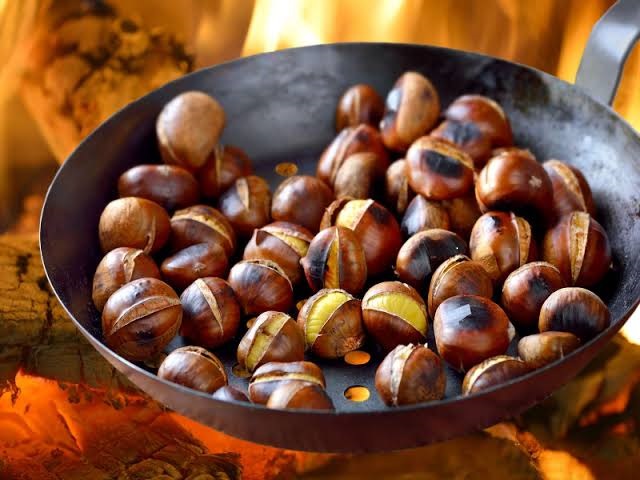
Fresh chestnuts have a mild sweetness, earthy aroma and soft, starchy texture once cooked.
Roasting brings out their characteristic warmth.
The inside becomes softer and creamier, while the outer shell develops a smoky aroma.
That is why roasted chestnuts are such a natural match for autumn.
They are warm.
They are comforting.
And they are best eaten slowly.
The Classic Kashmir Experience: Roast Them
There is perhaps no better way to enjoy fresh sweet chestnuts than roasting them.
At home, they can be:
- Roasted in an oven
- Pan-roasted
- Cooked over suitable heat
- Prepared using traditional roasting methods
Before roasting, the shells should be carefully scored to allow steam to escape.
Once cooked, allow them to cool enough to handle, then peel away the outer shell and inner skin.
The reward is a warm, soft kernel with a naturally sweet, buttery-earthy flavour.
A simple serving idea
Serve freshly roasted chestnuts with:
Kashmiri Kahwa + a warm blanket + an autumn evening.
You have, in one sitting, most of what makes Kashmir’s autumn special.
Why Chestnuts Are Different From Most Nuts
This is one of the most interesting things about chestnuts.
Unlike almonds, walnuts and many other commonly eaten nuts, sweet chestnuts are relatively low in fat and higher in carbohydrate, with a different nutritional profile.
USDA food-composition data for European chestnuts records substantially lower fat content than many familiar tree nuts, while chestnuts provide carbohydrates and useful amounts of minerals.
That makes chestnuts nutritionally quite different from the typical “high-fat nut” category.
They are better thought of as a starchy, energy-providing nut rather than simply another source of concentrated dietary fat.
Seasonal & Urgent
Taste Kashmir Before the Season Ends
Fresh Kashmir chestnuts are a short-season delicacy. If you’ve been waiting to experience their naturally sweet, earthy flavour, now is the time.
Order fresh Kashmir chestnuts from Kashmir Store and bring a taste of the Valley’s autumn harvest to your home.
What Nutrients Do Chestnuts Provide?
Chestnuts can contribute several nutrients to the diet, including:
Dietary fibre
Fibre contributes to normal digestive health and can help make foods more filling.
Vitamin C
Chestnuts are unusual among nuts because fresh chestnuts can provide vitamin C.
Potassium and other minerals
Chestnuts provide minerals including potassium, although the precise nutritional composition varies with variety and preparation.
Complex carbohydrates
Their carbohydrate-rich profile makes them useful as an energy-containing food.
Relatively low fat
Compared with many common tree nuts, chestnuts contain much less fat. USDA food-composition data illustrates this difference clearly.
However, “healthy” does not mean unlimited.
Chestnuts are still a food, and portion size and preparation matter—particularly when they are roasted with added butter, sugar or other ingredients.
Are Chestnuts Good for Health?
They can be a nutritious addition to a balanced diet.
But some of the stronger claims often made in promotional material need to be toned down.
Chestnuts can contribute fibre, vitamin C, carbohydrates and minerals, but they should not be marketed as a treatment for disease or as a guaranteed way to “boost immunity”, “strengthen the heart” or prevent medical conditions.
The more accurate message is simpler:
Chestnuts are a naturally nutrient-containing seasonal food with a distinctive nutritional profile.
And that is more than enough reason to enjoy them.
Fresh, Roasted or Dried: Which Should You Choose?
The choice depends on how you want to eat them.
Fresh Chestnuts
Best when you want the authentic seasonal experience.
They have a higher moisture content and a softer, fresher character after cooking.
Best for: roasting and immediate consumption.
Roasted Chestnuts
The classic autumn snack.
Roasting intensifies their aroma and softens the interior.
Best for: evening snacking and family gatherings.
Dried Chestnuts
Drying extends their usability and allows the crop to be preserved beyond the fresh season.
This is particularly important in regions where seasonal foods have traditionally been preserved for later consumption.
Best for: longer storage and traditional preparations.
How Short Is the Fresh Chestnut Season?
That depends on the crop, locality, harvest timing and storage conditions.
But compared with many commercially available nuts, fresh chestnuts have a relatively limited keeping quality.
Botanical references note that fresh sweet chestnuts can spoil relatively quickly if they are not stored appropriately.
That is part of the reason fresh chestnuts are strongly associated with their harvest season.
You do not simply find the same quality sitting on shelves indefinitely.
When the autumn crop arrives, the clock is already running.
Why Fresh Chestnuts Need Better Handling
Fresh chestnuts contain considerably more moisture than dried nuts.
That makes storage important.
If you are buying them fresh:
- Keep them cool.
- Avoid prolonged exposure to heat.
- Check for mould or damaged shells.
- Do not store damaged nuts with healthy ones.
- Follow the seller’s storage instructions.
- Cook promptly when the product is sold specifically as fresh.
If a seller describes the product as fresh, ask when it was harvested or sourced and how it has been stored.
That small question can make a big difference.
Fresh. Seasonal. Kashmiri.
Kashmir’s fresh chestnuts have arrived—and the season won’t wait.
Roast them. Share them. Enjoy them warm.
Order Fresh Kashmir Chestnuts from Kashmir Store Today.
Kashmir’s Chestnut Story Is Also a Livelihood Story
There is another side to the chestnut season that is easy to miss.
Behind the snack is an agricultural economy.
Kashmir’s chestnut harvest has historically supported growers, collectors, vendors and seasonal workers. Research has described chestnut as an underutilised but economically and environmentally relevant crop within Himalayan agroforestry systems.
That makes the chestnut more than an exotic food for urban consumers.
It is part of a rural production chain.
When consumers choose responsibly sourced seasonal chestnuts, they are participating in that chain.
A Seasonal Food That Deserves More Attention
Kashmir is famous for apples.
It is famous for walnuts.
It is famous for saffron.
But the Valley’s food story is much larger.
There are lotus stems, dried vegetables, morels, honey, traditional spices, water chestnuts and a wide range of seasonal produce.
Sweet chestnuts occupy a quieter corner of that landscape.
Perhaps that is precisely what makes them interesting.
They are not an everyday supermarket staple.
They appear.
Autumn arrives.
The chestnuts come into the markets.
People roast them.
Families enjoy them.
And then, almost as quickly as they arrived, the season moves on.
How to Enjoy Kashmir Chestnuts at Home
Want to make your order feel like a proper Kashmiri autumn evening?
Try this simple combination:
The Kashmir Autumn Snack Plate
Roasted fresh chestnuts
Warm and freshly peeled.
Kahwa
Green tea with aromatic spices, served hot.
Walnuts and almonds
For contrast in texture.
A little saffron
For the unmistakable fragrance of Kashmir.
Soft music and warm lighting
Optional—but highly recommended.
It is a simple spread.
Yet it captures the season remarkably well.
Tentative Price Guide for Fresh Kashmir Chestnuts
Chestnut prices can change considerably depending on harvest conditions, size, freshness, sourcing location, transport and retail margins.
Recent local reporting provides a useful benchmark: Kashmir Observer reported fresh roasted chestnuts selling at around ₹2000 – ₹3000 per 1000 grams in September 2026, compared with roughly ₹500 the previous year. That works out to approximately ₹1,500 per kg at that reported retail level.
However, this should not be treated as a universal Kashmir-wide price.
For online retail and home delivery, buyers should expect the final price to depend on:
- Quantity
- Freshness
- Harvest date
- Packaging
- Delivery distance
- Seasonal demand
- Sorting and grading
Practical buying guide
250 grams: approximately ₹550–₹800+
500 grams: approximately ₹1000–₹1800+
1 kg: approximately ₹2500–₹3,500+
These are indicative promotional ranges only, not fixed quotations.
Why Buy Fresh Chestnuts Before the Season Moves On?
Because this is precisely the kind of food that loses some of its charm when you treat it like an ordinary pantry item.
Fresh chestnuts are about timing.
They are about harvest.
They are about autumn.
They are about opening a packet, roasting the nuts and eating them while they are still warm.
And unlike imported nuts that may be available almost year-round, the appeal of Kashmir’s fresh chestnut is closely tied to the season.
From Kashmir’s Autumn Orchards to Your Table
There is something wonderfully old-fashioned about seasonal food.
It teaches patience.
You cannot demand that autumn arrive in July.
You cannot make every harvest last forever.
And you cannot completely reproduce the experience of eating something fresh at the moment it belongs to.
That is what makes Kashmir’s chestnuts special.
They arrive with the season.
They carry the earthy flavour of the Valley.
They are connected to local agriculture and traditional food habits.
And they disappear again, leaving consumers waiting for the next harvest.
Kashmir Chestnuts Have Arrived
For anyone who loves discovering lesser-known Kashmiri delicacies, this is the time to try them.
Fresh Kashmir sweet chestnuts are now making their seasonal appearance.
Roast them.
Peel them.
Share them.
And enjoy one of Kashmir’s most distinctive autumn foods while the season lasts.
Freshly sourced Kashmir Chestnuts — a seasonal taste of the Valley, available for a limited time.
Order early while seasonal stocks last.
Fresh chestnut availability, pricing, grade and delivery depend on harvest and storage conditions. Buyers should confirm current stock and final price before ordering. Nutritional information is general and should not be interpreted as medical advice.
Taste Kashmir’s Autumn — Order Fresh Chestnuts Today.