What Does a GI Tag Really Mean? A Buyer’s Guide to Authentic Kashmiri Products
GI-Tagged Products of Kashmir: Discover the Heritage, Craftsmanship and Meaning Behind the Tag
By: Kashmir Store | October 2026
From the celebrated saffron fields of Pampore to the intricate artistry of Kani shawls, Kashmir’s traditional products carry stories that have travelled across generations. The Geographical Indication tag helps protect that identity. But what does it really mean for buyers, and how can consumers make more informed choices?
A beautifully woven Pashmina shawl, a carefully crafted walnut-wood artefact, a box of fragrant Kashmiri saffron or a piece of intricate Papier-Mâché work — some products carry much more than their price tags.
They carry the identity of a place.
They reflect the skills of artisans, the knowledge of traditional producers, the natural conditions of a particular region and techniques that have often been preserved within families for generations.
This is what makes Kashmir’s traditional products so distinctive.
But as regional handicrafts and agricultural products reach customers across India and international markets, another question has become increasingly important: how can buyers distinguish a genuinely recognised regional product from an imitation or a loosely labelled alternative?
One important part of the answer is the Geographical Indication (GI) tag.
GI recognition helps protect products whose qualities, reputation or characteristics are connected to a particular geographical area. It gives traditional producers a framework to protect the identity of their products and helps consumers understand what a regional name represents.
For Kashmir, this recognition covers a fascinating collection of agricultural products, foods and traditional crafts.
Understanding the GI tag is therefore not just about buying a product. It is about appreciating the heritage behind it.
What Is a GI Tag?
A Geographical Indication, commonly known as a GI tag, is a form of intellectual property protection given to products that originate from a defined geographical area and possess qualities, reputation or characteristics essentially linked to that location.
In simple language, a GI tag identifies a product with the place that gives it its distinctive identity.
Think of Darjeeling Tea, Banarasi Brocade, Kanchipuram Silk or Kashmir Pashmina.
Their names are associated with specific regions and traditional methods of production.
A GI registration helps prevent unauthorised use of the protected geographical name and provides a legal framework for safeguarding the product’s reputation.
In India, Geographical Indications are protected under the Geographical Indications of Goods (Registration and Protection) Act, 1999.
The system covers several categories, including:
- Agricultural products
- Food products
- Natural products
- Handicrafts
- Manufactured goods
According to the Government of India’s Cell for IPR Promotion and Management (CIPAM), GI recognition helps protect traditional knowledge and skills, preserve cultural heritage and support regional economies.
For consumers, it provides an important reference point when evaluating products marketed under recognised geographical names.
Why Kashmir’s GI-Tagged Products Matter
Kashmir’s reputation has been built through more than its landscapes.
The region is known for its saffron cultivation, Pashmina weaving, embroidery, wood carving, traditional architecture, carpets and decorative arts.
Many of these products require specialised knowledge.
A traditional Kani shawl, for example, is not simply a piece of fabric with an attractive pattern. Its production involves a complex weaving technique using small wooden sticks known as Kanis or Tujlis.
Similarly, authentic Kashmir Pashmina is associated with specific fibre and production requirements, including fine Pashm fibre and hand-spun, hand-woven fabric.
These characteristics are central to the product’s identity.
GI recognition helps connect the name of the product with the geographical origin, production specifications and traditional knowledge that make it special.
It also provides a stronger foundation for protecting genuine producers from misleading imitations.
A Look at GI-Tagged Products of Jammu and Kashmir
The official Indian GI Registry includes a growing collection of products associated with Jammu and Kashmir.
The registered products cover agriculture, food and handicrafts. Importantly, the list includes products from both the Kashmir Valley and the wider Jammu region.
Here are some of the best-known examples.
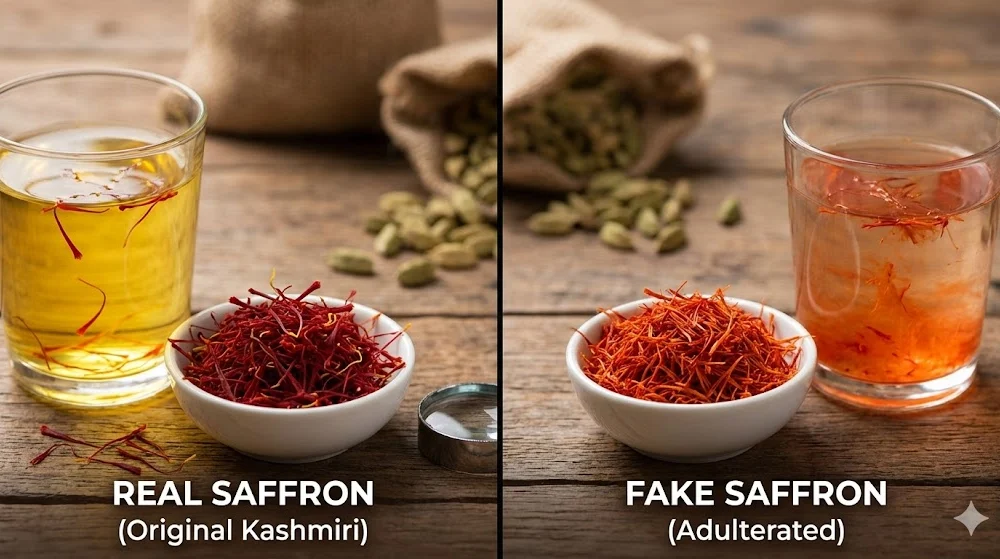
1. Kashmir Saffron — The Red Gold of Pampore
Few agricultural products are as closely associated with Kashmir as saffron.
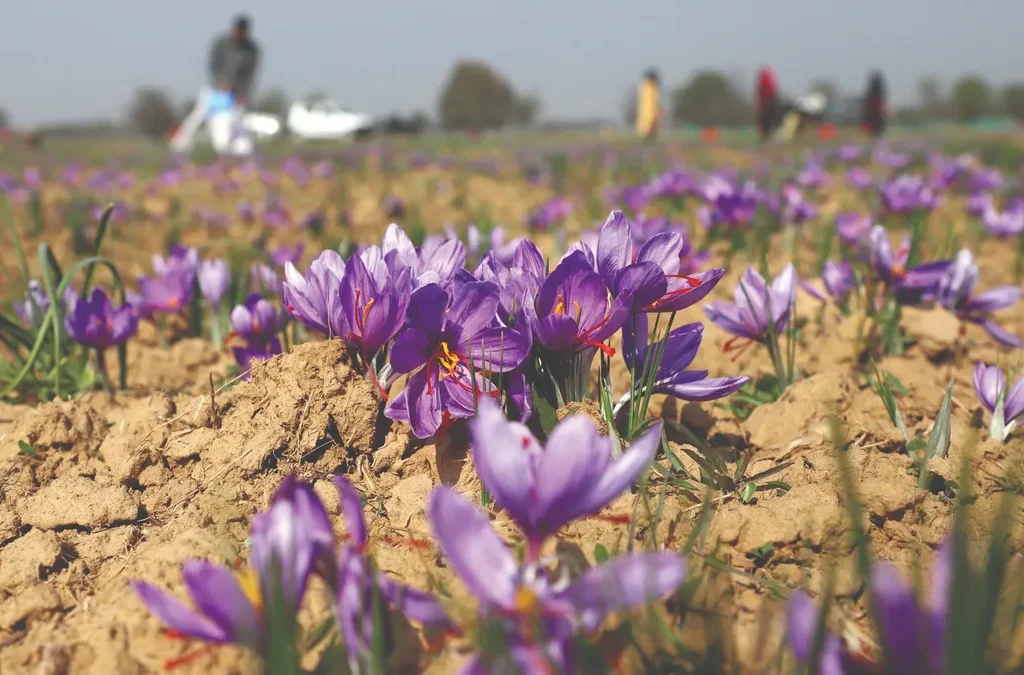
Cultivated particularly around Pampore in Pulwama district, Kashmir Saffron is produced from the delicate stigmas of the Crocus sativus flower.
The spice is recognised for its distinctive aroma, colouring properties and flavour.
Its cultivation and processing involve considerable manual work. The flowers are harvested during a short flowering season, and the delicate red stigmas are carefully separated and dried.
Kashmir Saffron received GI registration in 2020 under Application No. 635.
For buyers, this recognition is important because it protects the geographical identity associated with the product.
However, a packet advertised as Kashmir Saffron should still be checked for credible origin information, seller details and available quality documentation.
What to look for: Clear origin details, appropriate packaging, batch information and credible product testing where available.
2. Kashmir Pashmina — A Tradition Woven by Hand
Kashmir Pashmina is one of the Valley’s most recognised textile traditions.
Known for its fine texture, warmth and lightweight character, authentic Pashmina is associated with the fine under-fleece fibre of the Himalayan mountain goat.
The registered GI specifications describe Kashmir Pashmina as fabric made from 100% Pashm fibre, with fineness of up to 16 microns, using hand-spun yarn and hand-woven by artisans of Jammu and Kashmir.
This is a significant distinction.
Not every soft shawl sold under the general name Pashmina automatically qualifies as GI-recognised Kashmir Pashmina.
The raw material, production process and finished product must meet the applicable specifications.
What to look for: Fibre information, hand-spinning and hand-weaving details, appropriate GI identification and credible seller documentation.
3. Kani Shawl — The Art of Intricate Weaving
A Kani shawl is among the most distinctive examples of Kashmir’s weaving heritage.
Its elaborate patterns are created using small wooden sticks called Kanis or Tujlis instead of a conventional shuttle for inserting the coloured weft yarns.
The designs are guided by written instructions known as Talim.
The weaving technique requires considerable skill, concentration and patience.
Complex patterns may take substantial time to complete, making traditional Kani shawls particularly valued among collectors and textile enthusiasts.
The Kani Shawl received GI registration in 2006.
What to look for: Traditional Kani weaving, craftsmanship details, pattern construction and the product’s GI-related documentation.
4. Kashmir Sozani Craft — Fine Needlework and Detail
Sozani is a traditional Kashmiri embroidery technique known for delicate needlework and intricate patterns.
Artisans use fine stitches to create floral motifs, leaves, natural forms and other traditional designs.
The beauty of Sozani lies in its precision.
A detailed piece can require hours or even much longer, depending on the complexity and density of the embroidery.
Kashmir Sozani Craft is GI registered.
What to look for: Fine needlework, stitch details, the artisan’s workmanship and reliable information about the product’s origin.
5. Kashmir Papier-Mâché — Colour, Creativity and Heritage
Kashmir Papier-Mâché is one of the Valley’s most recognisable decorative crafts.
The technique combines prepared paper material with traditional shaping, surface preparation, painting and decorative finishing.
Artisans create a wide range of objects, including:
- Decorative boxes
- Jewellery cases
- Christmas ornaments
- Bowls and trays
- Wall décor
- Vases
- Decorative panels
- Gift articles
Traditional designs often feature floral patterns, natural motifs and intricate detailing.
The craft is GI registered and represents an important part of Kashmir’s artistic heritage.
What to look for: Handcrafted detailing, painted designs, finishing quality and information about the maker or source.
6. Kashmir Walnut Wood Carving — The Beauty of Natural Wood
Walnut wood carving is another craft closely associated with Kashmir.
Local artisans transform walnut wood into furniture, decorative panels, boxes, tables and household objects.
The craft is particularly admired for its detailed carving, floral motifs and the natural appearance of the wood.
Traditional pieces can involve considerable manual work.
Kashmir Walnut Wood Carving received GI registration in 2009.
What to look for: Wood identification, carving quality, finishing, construction and reliable product-origin information.
7. Khatamband — Traditional Geometric Woodwork
Khatamband is a distinctive architectural craft associated with Kashmir’s traditional interiors.
It involves assembling carefully shaped wooden pieces into intricate geometric patterns.
The pieces are fitted together through traditional joinery techniques rather than simply relying on nails or glue.
Khatamband has historically been used in ceilings and interior decoration, particularly in traditional homes and heritage buildings.
Today, its visual appeal also inspires contemporary interior design.
What to look for: Traditional geometric construction, quality of joinery, material details and craftsmanship.
8. Kashmiri Hand Knotted Carpet — A Legacy Underfoot
Kashmiri hand-knotted carpets are recognised for their intricate patterns, traditional designs and labour-intensive production.
The process involves tying individual knots to create the pile of the carpet.
Designs may feature floral arrangements, medallions, garden-inspired motifs and intricate borders.
The quality of a carpet depends on several factors, including materials, knotting, construction, design complexity and finishing.
Kashmiri Hand Knotted Carpet received GI registration in 2015.
What to look for: Hand-knotting details, material composition, dimensions, knot density, construction and product documentation.
9. Basohli Painting — A Colourful Artistic Tradition
Basohli Painting originates from the Basohli region of Kathua district in Jammu.
It is known for its distinctive visual language, bold colours, expressive figures and traditional themes.
The painting tradition is particularly associated with the artistic heritage of the Jammu region.
Basohli Painting received GI registration in 2021.
Its inclusion is an important reminder that the GI portfolio of Jammu and Kashmir represents more than the Kashmir Valley alone.
10. Rajouri Chikri Wood Craft — A Distinctive Jammu Craft
Rajouri Chikri Wood Craft is associated with the Rajouri region of Jammu.
It represents a traditional woodcraft practice involving the use of locally associated Chikri wood and skilled craftsmanship.
The craft received GI registration in 2021.
It deserves recognition alongside the better-known crafts of Kashmir because it represents the wider cultural and artistic diversity of Jammu and Kashmir.
More GI-Registered Products From Jammu and Kashmir
The official state-wise GI register also includes several agricultural products, food specialities and crafts that deserve attention.
These include:
| Product | Category | Associated region or identity |
|---|---|---|
| Mushqbudji Rice | Agricultural | Kashmir |
| Bhaderwah Rajmash | Agricultural | Bhaderwah, Jammu |
| Ramban Anardana | Agricultural | Ramban, Jammu |
| Ramban Sulai Honey | Food stuff | Ramban, Jammu |
| Udhampur Kaladi | Food stuff | Udhampur, Jammu |
| Basohli Pashmina Woollen Products | Handicraft | Basohli, Jammu |
| Kashmir Namda | Handicraft | Kashmir |
| Kashmir Wagguv | Handicraft | Kashmir |
| Shikara | Handicraft | Kashmir |
| Gabba | Handicraft | Kashmir |
| Kashmir Willow Bat | Handicraft | Kashmir |
| Kashmir Chain Stitch | Handicraft | Kashmir |
| Kashmir Crewel | Handicraft | Kashmir |
| Kashmir Tweed | Handicraft | Kashmir |
The official registry records these products as registered GIs under the Jammu and Kashmir geographical classification.
The geographical identity of each product should be checked individually. A Jammu-region GI product should not be inaccurately presented as originating in the Kashmir Valley.
GI Tag vs Quality Certificate: An Important Difference
This is one of the most important things buyers should understand.
A GI tag and a quality certificate are not the same.
A GI tag protects the geographical identity of a product and the qualities, reputation or characteristics associated with its origin.
A quality certificate or laboratory test, on the other hand, may assess specific product characteristics.
For example:
- GI registration identifies the protected geographical product.
- Laboratory testing may assess saffron’s quality parameters.
- Fibre testing may help verify the composition of a textile.
- Craft inspection may assess whether a product follows the relevant specifications.
A GI tag should therefore not be interpreted as an automatic guarantee that every individual item has been independently tested for every possible quality characteristic.
Consumers should look for appropriate product information and documentation.
What Does a GI Tag Mean for Buyers?
For a customer, GI recognition can offer several important advantages.
Greater Confidence in Product Identity
A protected geographical name gives buyers a recognised reference for understanding where a product comes from and what distinguishes it.
Protection Against Misleading Geographical Claims
GI law provides protection against unauthorised use of registered geographical names.
Better Understanding of Traditional Craftsmanship
The product specifications can help customers appreciate the methods and materials associated with traditional goods.
Support for Regional Producers
Choosing genuine GI products can help strengthen demand for traditional producers and artisan communities.
More Informed Shopping Decisions
Consumers can compare products more carefully by checking origin, materials, production methods and documentation.
How to Buy Genuine GI-Tagged Products of Kashmir
A GI label is useful, but buyers should still be careful when shopping online or in physical markets.
Here are some practical checks.
1. Verify the product name. Check whether the exact product is registered under a GI, rather than relying on a general regional description.
2. Ask about the geographical origin. The product should come from the geographical area defined in its GI registration.
3. Check the seller’s details. Look for a clear business identity, contact information and product description.
4. Ask about authorised-user or producer details. Where relevant, ask whether the producer or seller is connected to the registered GI framework.
5. Understand the specifications. For Pashmina, check fibre and weaving details. For carpets, examine knotting and construction. For saffron, check origin and quality documentation.
6. Be cautious of unusually low prices. Traditional handwork and genuine materials involve costs that should be reflected in the price.
7. Request supporting documentation. Product-specific testing, traceability or GI identification can provide additional confidence.
Why GI Recognition Is Important for Kashmiri Artisans
The importance of GI recognition extends far beyond the consumer market.
Traditional crafts face several challenges.
Mass-produced imitations can compete with handmade products at much lower prices. Consumers may not understand the difference between traditional craftsmanship and factory-made alternatives. Artisans can also struggle to communicate the value of the work involved in producing an authentic item.
GI recognition provides a legal framework for protecting geographical identity and discouraging misleading commercial use.
It can also strengthen the market position of genuine producers.
However, registration alone cannot solve every challenge.
Artisans still need access to markets, fair compensation, training, better production facilities, transparent supply chains and effective enforcement.
The long-term value of GI protection depends on how well the system works for the people who actually produce these goods.
Taking Kashmir’s Heritage Beyond the Valley
Kashmir’s traditional products are increasingly reaching customers who may never have visited the region.
A person buying a Pashmina shawl in Delhi, a walnut-wood artefact in Mumbai or Kashmiri saffron in Bengaluru is also discovering a small part of the Valley’s cultural identity.
Online marketplaces can help make that connection easier.
But the responsibility is equally important: product descriptions should be accurate, claims should be supported and traditional craftsmanship should be represented honestly.
At Kashmir Store, customers can explore Kashmiri food products, traditional specialities and heritage-inspired offerings.
Whether you are interested in saffron, Pashmina, dry fruits or handcrafted products, take the time to understand the story and specifications behind the item.
Explore the heritage of Kashmir at Kashmir Store.
The Future of GI-Tagged Products of Kashmir
The future of Kashmir’s GI products depends on more than protecting names.
It depends on preserving the skills and knowledge behind them.
For agricultural products, this means supporting growers, improving post-harvest handling, building traceability and reaching wider markets.
For handicrafts, it means protecting traditional methods, encouraging younger artisans, supporting fair pricing and helping consumers recognise genuine workmanship.
Digital marketplaces can contribute by making product information easier to access and by connecting regional producers with customers across India and abroad.
The opportunity is significant.
Kashmir’s GI products are not merely souvenirs or luxury purchases. They are part of a living heritage that deserves recognition, responsible marketing and sustainable commercial opportunities.
Frequently Asked Questions About GI-Tagged Products of Kashmir
1. What does a GI tag mean?
A Geographical Indication tag identifies a product whose qualities, reputation or characteristics are essentially linked to a particular geographical origin. It also provides legal protection for the registered product name.
2. Which Kashmir products have GI tags?
Examples include Kashmir Saffron, Kashmir Pashmina, Kani Shawl, Kashmir Sozani Craft, Kashmir Paper Machie, Kashmir Walnut Wood Carving, Khatamband and Kashmiri Hand Knotted Carpet. The wider Jammu and Kashmir GI portfolio includes several additional agricultural products and handicrafts.
3. Is Kashmiri Pashmina GI tagged?
Yes. Kashmir Pashmina is registered under India’s GI system. Its specifications include requirements relating to Pashm fibre and traditional hand-spun and hand-woven production.
4. Is Kashmir Saffron GI tagged?
Yes. Kashmir Saffron received GI registration under Application No. 635 in 2020.
5. Does a GI tag guarantee that every product is premium quality?
No. GI registration protects geographical identity and the product’s recognised specifications. Buyers should still check the actual product, materials, seller details and appropriate quality documentation.
6. Is every Kashmiri handicraft GI tagged?
No. Many traditional Kashmiri crafts are not necessarily registered as GIs. Buyers should verify the exact product name against the official GI register.
7. Are Basohli Painting and Rajouri Chikri Wood Craft Kashmir Valley products?
They are associated with the Jammu region of the Union Territory of Jammu and Kashmir. They should not be described as products originating specifically from the Kashmir Valley.
8. How can I verify a GI product?
Search the official Geographical Indications Registry, check the registered product specifications and ask the seller for relevant producer, authorised-user or product documentation.
9. Does buying GI-tagged products support artisans?
Purchasing genuine products can help strengthen demand for traditional producers and artisan communities. The actual benefit depends on fair sourcing, transparent supply chains and whether producers receive a reasonable share of the value.
10. Where can I explore Kashmiri products online?
Visit Kashmir Store to explore Kashmiri food products, traditional specialities and regional offerings.
A Heritage Worth Protecting
A GI tag may appear to be a small mark on a product label, but it represents something much larger.
It connects a product to a place, a community and a tradition.
It reminds buyers that a handmade shawl is not simply fabric, that a carved wooden object is not just furniture and that a few strands of saffron carry the story of an entire agricultural landscape.
When consumers understand the meaning behind the GI tag, they can make more informed choices and appreciate the people whose knowledge keeps these traditions alive.
Discover the products, craftsmanship and flavours of Kashmir. Explore Kashmir Store or call/WhatsApp +91 94697 2436 for assistance.